Table of Contents
ToggleLiving room shelves are prime real estate for personal style, yet too many sit half-empty or cluttered without intention. Whether you’re working with floating shelves, built-in bookcases, or a media console, the key is mixing form and function in a way that feels curated, not chaotic. This guide walks you through ten practical shelf <a href="https://brightspaceshomes.com/decorating-ideas-for-stairs-and-hallways/”>decorating ideas that balance books, plants, textures, and personal touches. You’ll learn how to arrange items so they look intentional and inviting, transforming those blank shelves into a focal point that reflects who you are.
Key Takeaways
- Follow the 60/40 rule—use roughly 60% functional items like books and baskets with 40% decorative pieces to create shelf decorating ideas that feel intentional without looking like a library catalog.
- Mix living plants or high-quality faux greenery with coordinated pots to soften shelves and add visual interest, grouping plants in odd numbers at varying heights.
- Use the rule of three to arrange items in harmonious groupings across your shelf, dividing space into small vignettes with balanced weight and visual density.
- Incorporate 2–3 accent colors throughout your display by repeating them across book spines, art, and decorative objects to create cohesive visual flow.
- Add texture and warmth through woven baskets, fabric elements, and varied materials to prevent your shelf from feeling flat or sterile.
- Display 2–3 framed family photos and meaningful personal objects at eye level to humanize the space and tell your story without scattering souvenirs randomly.
Balance Books With Decorative Objects
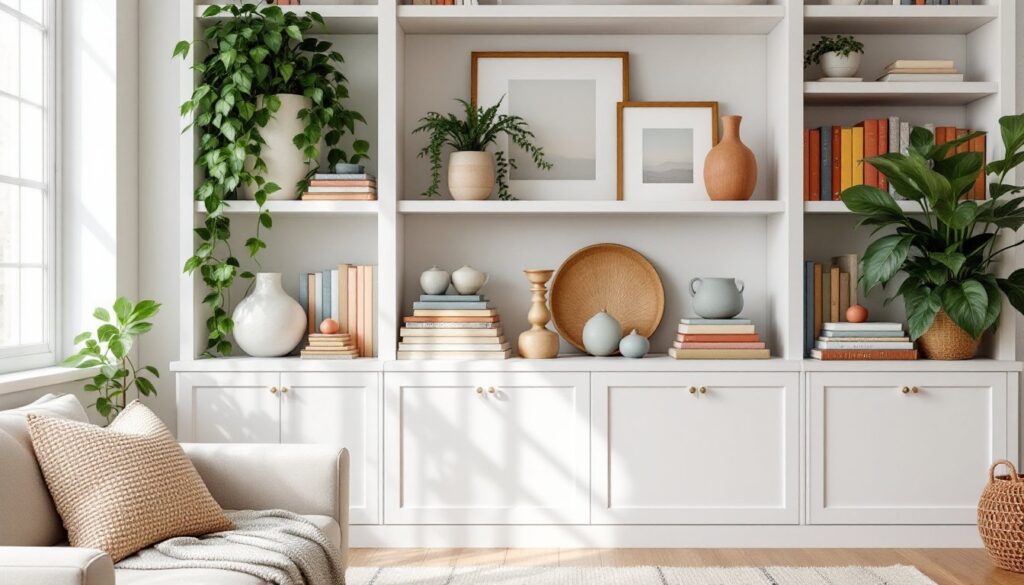
Books ground a living room shelf and give it substance. The trick is treating them as both reading material and decor. Lay some volumes flat, stack others upright, and let titles show front-facing if you’ve got nice spines. Don’t fill every inch with pages.
Intersperse books with decorative objects, a framed photo, a small sculpture, a trinket box. The 60/40 rule works well here: roughly 60% functional (books, baskets), 40% decorative (art, collectibles). This ratio prevents shelves from feeling like a library catalog while keeping them grounded.
Group books by color or size to create visual rhythm. A stack of earth-tone hardbacks paired with white ceramic next to a small wooden box creates natural interest without looking forced. Vary the direction: vertical books, horizontal stacks, a leaning piece. This prevents monotony and makes the shelf feel lived-in rather than staged.
Incorporate Plants and Greenery
A shelf without green feels sterile. Living plants or high-quality faux greenery immediately soften a display and add life, literally or the illusion of it. Consider your lighting. East or west-facing shelves near a window suit pothos, snake plants, or trailing philodendrons. Low-light shelves work fine with quality artificial plants: there’s no shame in faux if the alternative is a dead plant by fall.
Pot selection matters. A plant in a mismatched nursery pot looks temporary: repot it into something coordinated with your shelf’s color story. Ceramic, terracotta, or matte finishes usually feel more intentional than plastic.
Group plants in odd numbers: one tall plant flanked by two smaller ones creates balance. Mix heights by using plant stands or stacking books underneath pots. Leave breathing room, crowding plants looks cluttered. A trailing pothos draped over a shelf edge softens hard lines, while an upright snake plant adds vertical interest in a tight spot.
Add Texture With Woven Baskets and Fabric
Texture transforms a flat shelf into something tactile and inviting. Woven baskets (seagrass, rattan, wicker) store clutter while contributing warmth and dimension. Use baskets to corral items you don’t want visible, throws, remotes, magazines, while keeping the shelf looking curated.
Place a basket horizontally on a shelf, or stand it upright in a corner. Layer textures: combine a rough woven basket with smooth ceramics and glossy book covers. This interplay of materials prevents the shelf from feeling one-note.
Fabric bookends or a rolled linen throw add softness without eating much shelf space. A lightweight linen runner behind items creates depth and a subtle background. Avoid over-stuffing with texture: one or two woven or fabric elements per shelf is usually enough. The goal is warmth, not visual chaos.
Create Visual Interest With Color and Art
Color pulls a living room together. Choose 2–3 accent colors and repeat them across your shelf display. If your room leans neutral, introduce color through art, book spines, and small objects. Warm metallics (gold, brass) pair beautifully with earth tones: cool metallics (silver, chrome) suit blues and greens.
Small framed prints or a 4×6 photograph break up dense book arrangements. Lean a print against the back of the shelf for a casual, gallery-wall feel, or hang it above the shelf. Art doesn’t have to match perfectly, a mix of frame styles (wood, metal, painted) feels more curated than a matched set. Recent design trends suggest mixing vintage and modern frames creates visual depth.
Color-blocking, grouping similar-toned items together, sounds formal but works wonders. Stack warm-spined books next to coral ceramics and copper objects, then transition to cool blues and silver nearby. This creates visual flow without requiring perfection. A single pop-color object, like a mustard pillow leaning against books, draws the eye and prevents monotone fatigue.
Use Framed Photos and Personal Touches
Shelves tell your story. Include 2–3 framed family photos, travel photos, or meaningful prints. A living room shelf is more inviting when guests can see you’ve lived and loved, not just consumed. Mix frame sizes and finishes (wood, white, black, natural) for variety.
Personal objects, a small travel memento, a handmade gift from a friend, a ticket stub in a simple frame, humanize the space. These items need context though. Don’t scatter solo souvenirs across empty shelf space: group them. A small wooden box holding shells from a beach trip, flanked by a framed photo from that vacation, tells a complete story.
Consider candle decorating ideas alongside photos. A scented candle next to a travel photo creates atmosphere and nostalgia without feeling contrived. Arrange personal touches at eye level, typically the center or slightly lower third of the shelf, so they anchor the display and get noticed.
Arrange Items Using the Rule of Three
The rule of three is a design principle that works. Arrange objects in groups of three for visual harmony, a plant with a book and a small object, or three different heights of vases. Odd numbers feel less stiff than pairs or matched sets. Applied across a shelf, it prevents the “perfect symmetry” trap that makes displays feel sterile.
Think of your shelf as a series of small vignettes. Divide it mentally into thirds (or quarters on longer shelves), and create a mini-arrangement in each section. One section might be books + plant + framed photo: another could be basket + candlestick + sculpture. Each grouping stands alone but connects to its neighbors through color or material.
Balance weight and visual density. A heavy wooden object paired with an airy plant and a small book feels balanced. Two dense, dark objects next to a single light piece can look lopsided. Step back and squint at your arrangement, if the eye moves smoothly and nothing screams for attention, you’ve nailed it. Like arranging top of china cabinet decorating ideas, the best shelf displays look effortless because the planning is hidden.
Conclusion
A well-decorated living room shelf doesn’t happen by accident. It combines books, plants, texture, color, and personal meaning into an intentional display. Start with one section, apply these principles, and expand. Step back often, your eye catches things a photo misses. Your shelves should feel like home, not a store display. With these ten ideas, you’re ready to turn that blank wall into something that draws the eye and sparks conversation.